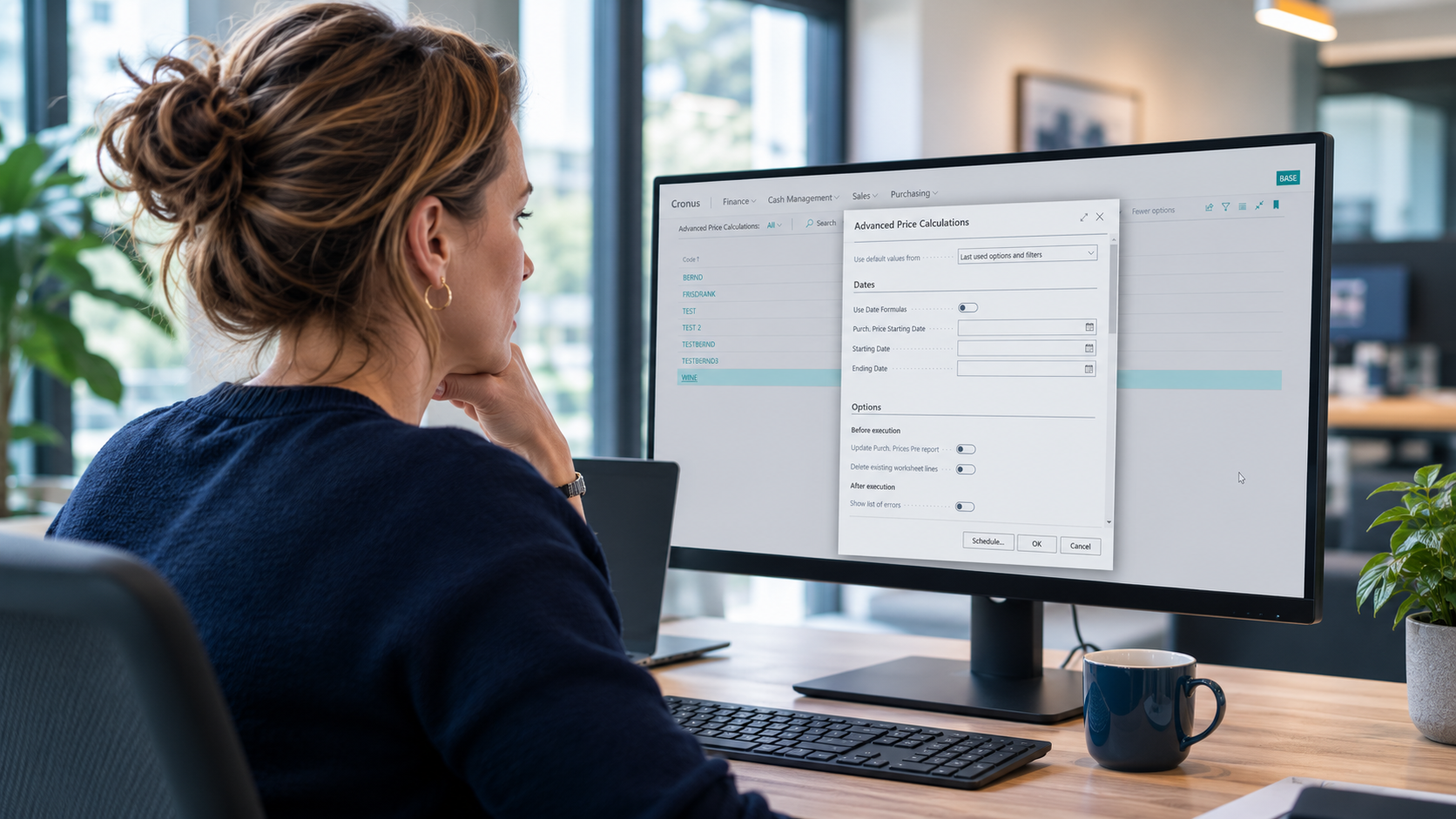
For many Dynamics GP users, Extended Pricing has become deeply embedded in the way they do business. Over the years, customer agreements, discount structures, pricing schedules and margin strategies have gradually found their way into the system.
That makes pricing one of the most important areas to get right when moving from Dynamics GP to Business Central.
It is also one of the areas where simply recreating the existing setup can mean missing a valuable opportunity.
Pricing has changed considerably over the past decade. Product portfolios have expanded, supplier prices change more frequently, margins are under greater pressure and customers increasingly expect agreements tailored to their specific relationship with a business. A pricing structure that has grown organically over many years may still work, but that does not necessarily mean it is the best foundation for the next ten.
A Business Central migration therefore creates a natural moment to take a step back. The objective should be to preserve the commercial logic behind the existing pricing model while looking at how that logic can be managed more efficiently going forward.
That is where Dynavision Pricing & Discounts comes into play. It extends standard Business Central pricing with hierarchical price calculation, advanced discount models, centralized price management and advanced sales price calculations. The result is a pricing framework designed around the way modern wholesale and distribution businesses actually manage prices, discounts and margins.
Why Dynamics GP Extended Pricing complexity grows with the business
Extended Pricing became powerful precisely because it allowed businesses to accommodate increasingly sophisticated commercial agreements. The downside is that complexity tends to accumulate.
New customer segments are introduced. Product portfolios expand. Suppliers change their prices. Different commercial teams negotiate different agreements. Promotions are added on top of existing discounts, while the business simultaneously tries to protect margins.
Each individual decision makes sense. Over time, however, the combination of those decisions can create a pricing environment filled with exceptions.
This is where pricing becomes a scalability issue.
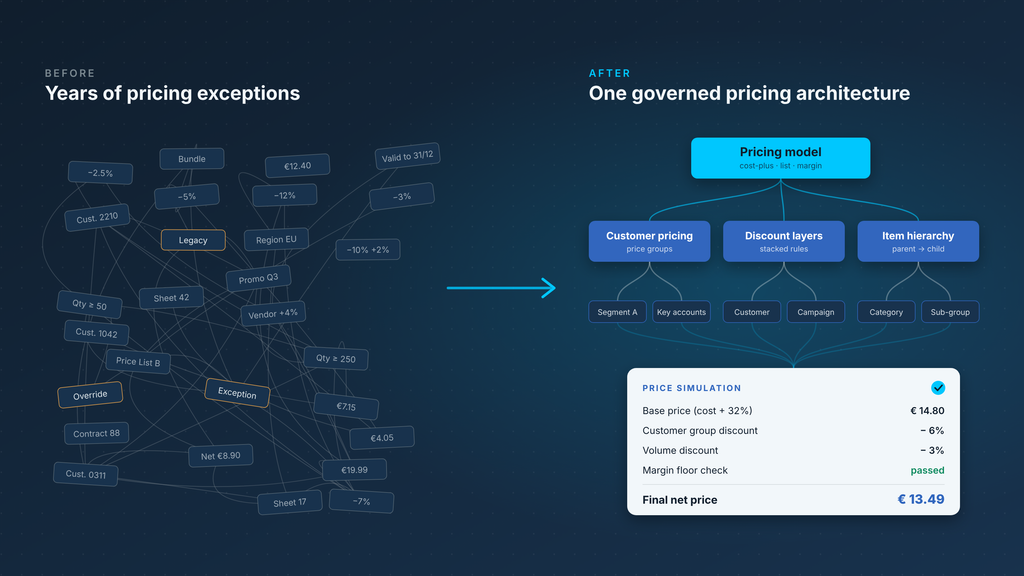
The effectiveness of a pricing solution depends not only on how many pricing scenarios it can support, but also on how easily those scenarios can be maintained, understood and governed. A pricing model that requires thousands of individual records and exceptions may deliver the right price today while becoming increasingly difficult to manage tomorrow.
Dynavision Pricing & Discounts addresses that challenge by introducing more structure into how prices and discounts are calculated and maintained.
Dynamics GP Extended Pricing vs. Dynavision Pricing & Discounts
| Capability | Dynamics GP Extended Pricing | Dynavision Pricing & Discounts |
|---|---|---|
| Customer-specific pricing | Yes | Yes |
| Customer group pricing | Yes | Yes |
| Quantity break pricing | Yes | Yes |
| Multiple discount layers | Limited | Native support |
| Fixed amount discounts | Limited | Native support |
| Combined percentage discounts | Limited | Native support |
| Hierarchical pricing logic | Limited | Yes |
| Hierarchical discount groups | No | Yes |
| Sales price list calculations | Limited | Extensive |
| Formula-driven pricing | Limited | Yes |
| Margin-based price generation | Limited | Yes |
| Price simulation | Basic | Extensive |
| Centralized price management | Limited | Yes |
| Multi-currency pricing | Yes | Yes |
| Digital label integration | No | Yes |
The important difference is not simply the number of capabilities available. It is how those capabilities can be combined into a pricing architecture that remains manageable as the business grows.
Customer pricing: a more structured approach than Dynamics GP Extended Pricing
Customer-specific and customer-group pricing are familiar concepts to most organizations using Extended Pricing. Dynavision supports both, while adding a configurable hierarchy to determine which price should ultimately be applied.
A hierarchy can, for example, evaluate pricing in the following order:
- Customer-specific pricing
- Customer Price Group pricing
- General customer pricing
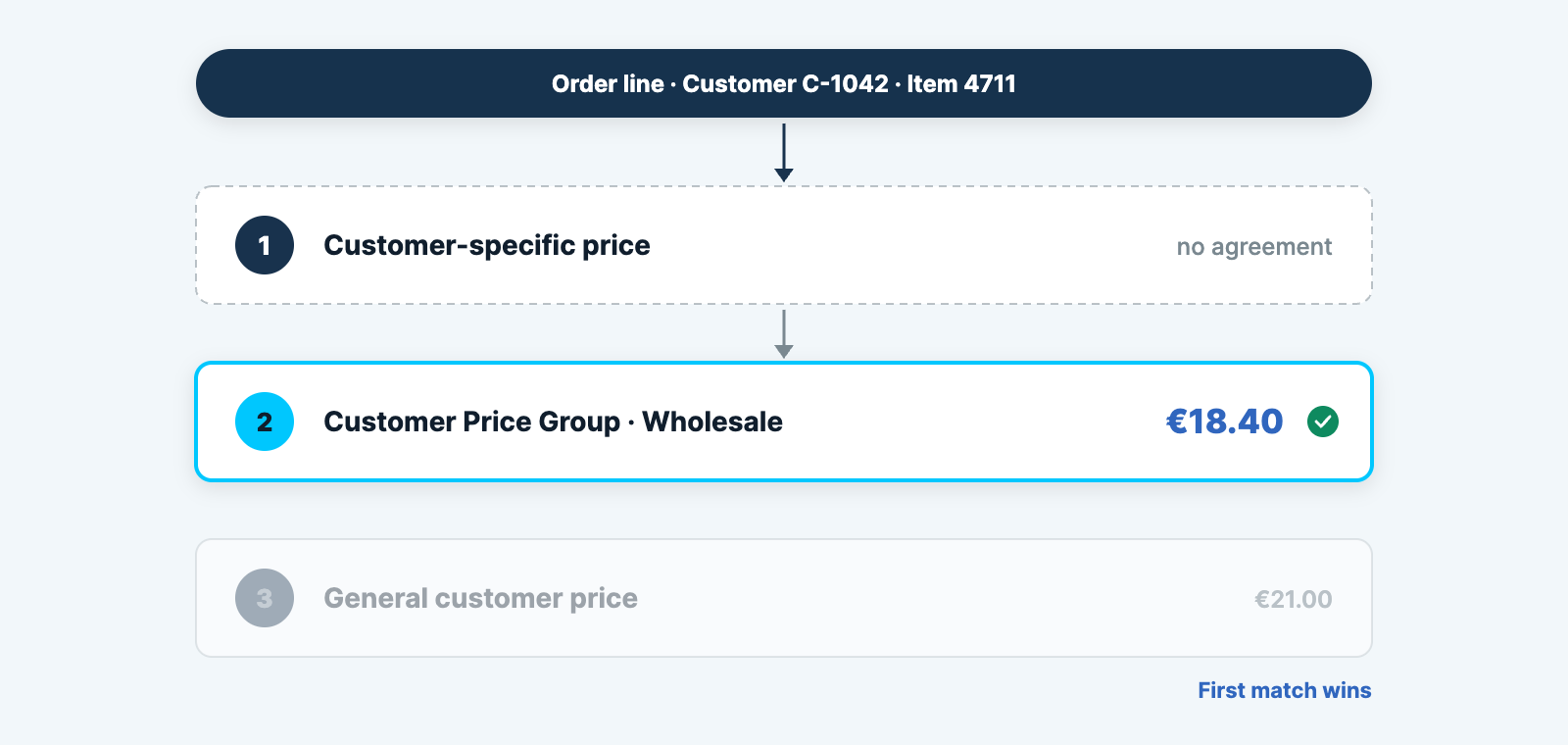
This creates a predictable structure for price determination. Instead of relying primarily on lowest-price logic or creating additional exceptions, businesses can define how different layers of pricing should interact.
For organizations with large customer bases or many individual customer agreements, that hierarchy can significantly reduce the volume of pricing exceptions that needs to be maintained.
Dynavision Advanced Pricing & Discounts supports this hierarchical price calculation as an alternative to standard lowest-price determination.
Bringing discount complexity under control
Discounts are often where commercial pricing becomes considerably more complicated.
A price agreement may be relatively straightforward, but discount agreements frequently overlap. Different customer segments can receive different percentage discounts, promotions may need to coexist with long-term commercial agreements, and fixed allowances sometimes need to be combined with percentage-based discounts.
Dynavision extends standard price lists with support for:
- Multiple simultaneous discounts
- Fixed amount discounts
- Combined discount calculations
- Discount management directly within price lists
Advanced Pricing & Discounts also supports combined percentage discounts, fixed amount discounts and amount-per-quantity discounts.
Bringing these mechanisms together creates a central framework for discount management and reduces the need to spread individual exceptions throughout the system. More importantly, it gives businesses a clearer view of the commercial rules that determine the final price offered to a customer.
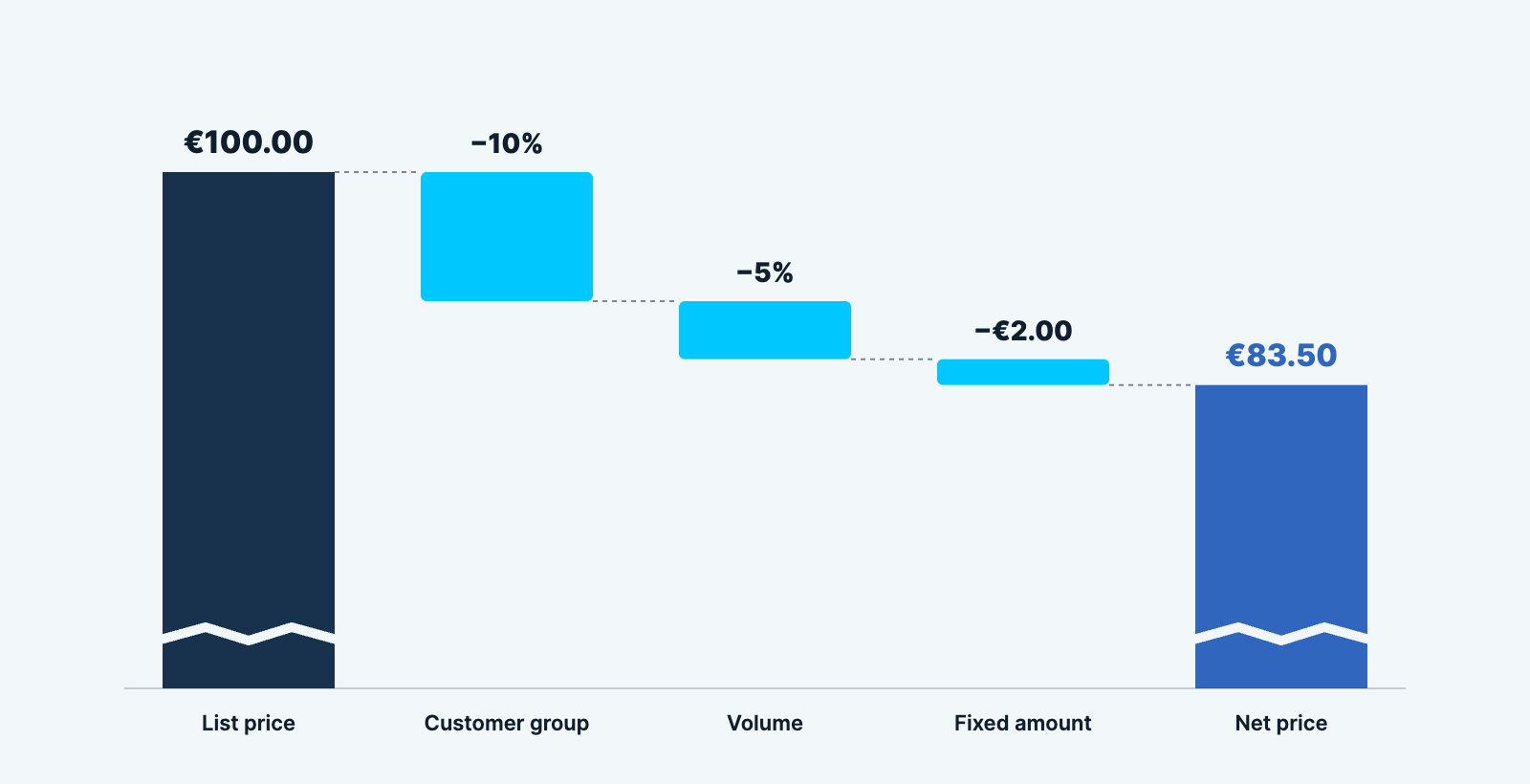
That transparency becomes increasingly valuable as organizations grow. The more discount layers a business introduces, the more important it becomes to understand who receives which discount, under what conditions and why.
Product hierarchies can dramatically reduce pricing maintenance
Large product portfolios create another scalability problem. When similar commercial rules apply across several product categories, traditional pricing structures can require the same or very similar rules to be maintained repeatedly.
Dynavision’s Item Discount Group Structure introduces parent-child relationships between product groups.
When the system cannot find a matching discount for a specific product group, it can move through the hierarchy and evaluate parent groups until an applicable discount is identified.
For example, instead of maintaining the same discount separately across multiple related categories, a broader commercial rule can be maintained at parent level while exceptions remain possible lower in the hierarchy.
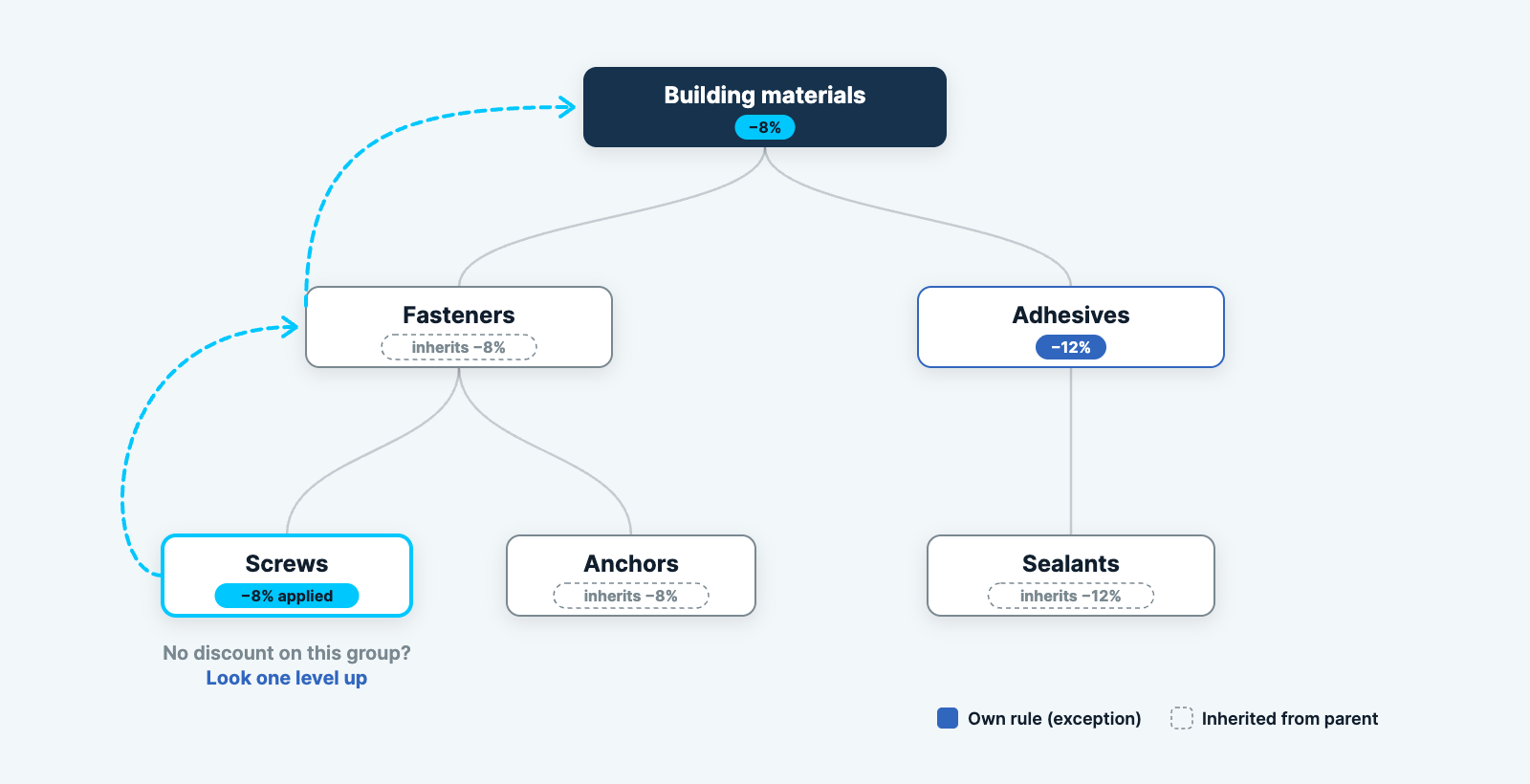
For organizations managing thousands of SKUs across multiple categories, this can substantially reduce duplication. The benefit goes beyond saving administrative time. Fewer duplicated pricing rules also make the overall pricing architecture easier to understand, govern and adapt.
Moving from price maintenance to price management
Perhaps the most strategically relevant capability is the way Dynavision approaches sales price list calculations.
In many ERP environments, a selling price is ultimately treated as a value that needs to be maintained. That model becomes difficult to sustain when supplier costs change frequently or when an organization manages a large catalogue.
A supplier increases its price, sales prices need to be reviewed, margins need to be checked and potentially large numbers of records need to be updated. At scale, maintaining consistency becomes increasingly difficult.
Dynavision introduces a sales price calculation framework that allows organizations to generate and manage sales prices based on predefined commercial logic.
Sales prices can be calculated using several possible sources, including:
- Lowest purchase price
- Highest purchase price
- Item Unit Cost
- Last Direct Cost
- Revaluation Cost
- Vendor-specific pricing
- Selected purchase prices
- Manually defined base prices
Advanced price calculations can then combine those sources with different lookup methods and calculation formulas.
This creates an important shift in how pricing can be managed. Instead of defining and maintaining every selling price individually, the business can determine the rules that should generate those prices.
Different products can follow different pricing models
A single pricing methodology rarely fits an entire product portfolio.
A wholesaler might use a relatively straightforward cost-plus model for commodity products, while strategic categories require tighter margin control. Specific products or customer segments may require entirely different calculations because of contractual agreements or competitive positioning.
Dynavision allows multiple sales price calculation models to coexist across customers, customer groups, item categories and commercial models.
Pricing teams can therefore define the appropriate commercial logic for each part of the business instead of forcing every product into the same calculation model.
As the organization grows, this model-based approach can deliver several long-term advantages:
- Reduced maintenance
- More consistent pricing
- Faster response to supplier changes
- Better pricing governance
- Improved margin control
- Easier onboarding of new products
These benefits become especially relevant for businesses where supplier prices, product portfolios and customer agreements change frequently.
Pricing models also provide a stronger foundation for margin protection
Margin erosion is rarely caused by one major pricing error. More often, it happens gradually.
Purchase costs increase while selling prices remain unchanged. Existing agreements stay active longer than expected. New products are introduced using outdated pricing assumptions. Over time, small discrepancies begin to affect profitability.
Connecting sales price generation more closely to underlying cost structures can make those discrepancies easier to manage.
With predefined calculation models, organizations can incorporate their margin strategy into the way prices are generated. Pricing management then becomes less dependent on manually reviewing individual selling prices whenever the commercial environment changes.
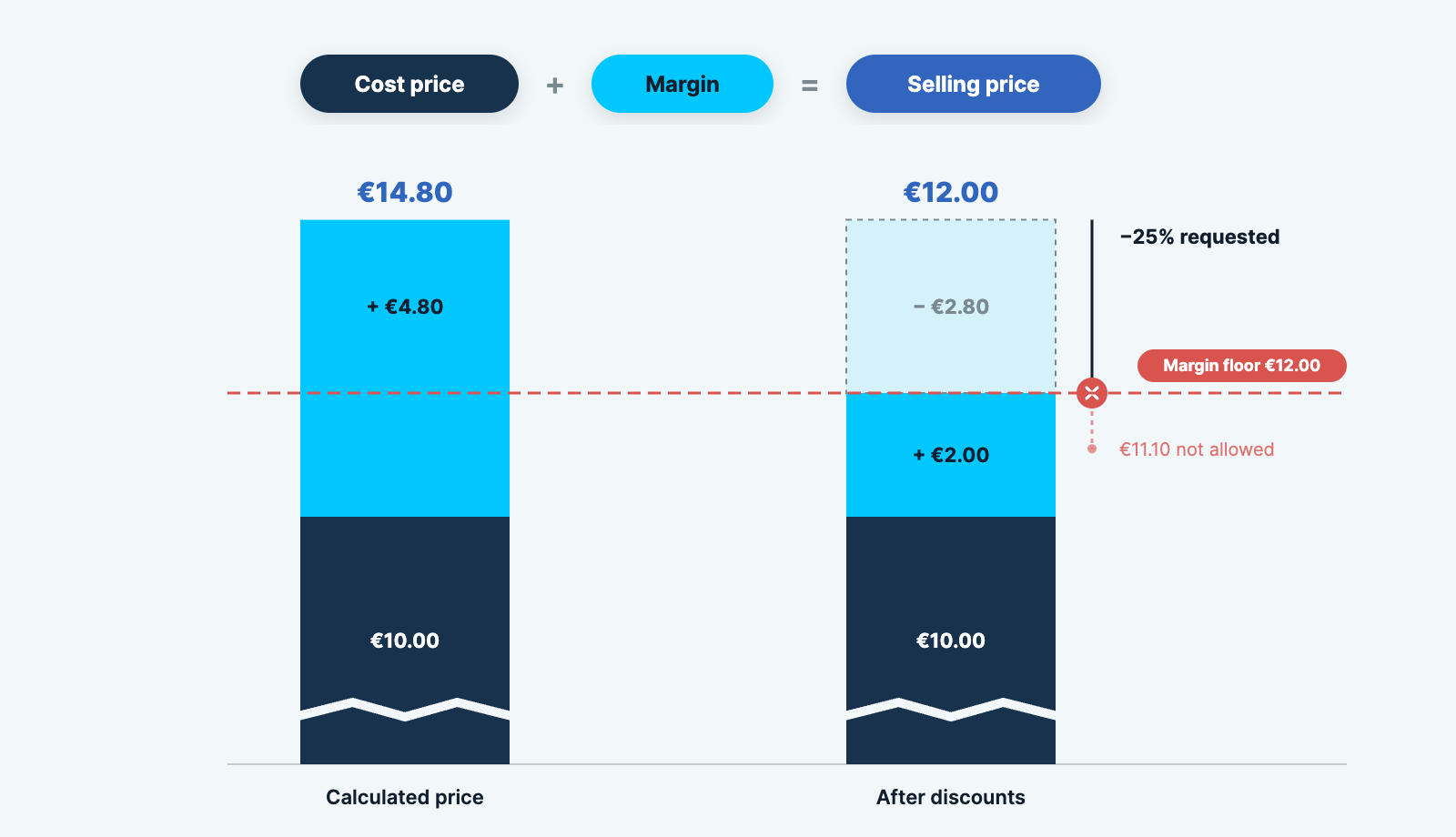
For Dynamics GP customers moving to Business Central, this can become one of the most valuable outcomes of revisiting the pricing architecture during migration. The ERP system becomes a way to consistently execute pricing strategy rather than simply a place where the resulting prices are stored.
Price simulation adds transparency to complex pricing
More sophisticated pricing rules also create a practical challenge: users need to understand how the system arrived at a particular price.
Dynavision includes Sales Price Simulation functionality that allows organizations to test pricing behaviour for a specific combination of:
- Customer
- Item
- Quantity
- Unit of Measure
- Date
The simulation shows which prices and discounts were evaluated and which pricing logic was ultimately applied.
This is particularly useful during a migration, when organizations need to validate that new pricing structures produce the intended commercial outcome. It can also support troubleshooting, user training and ongoing pricing governance after go-live.
Dynavision Connect includes pricing simulation functionality designed to analyse price and discount determination.
Migrating from Dynamics GP Extended Pricing is a chance to rethink pricing architecture
There is an understandable tendency during ERP migrations to use the existing environment as the blueprint for the new one. After all, the current configuration represents years of commercial knowledge and business decisions.
That knowledge absolutely needs to be preserved.
The more interesting opportunity lies in separating that commercial knowledge from the technical structures that happened to accumulate around it.
An Extended Pricing environment may contain thousands of records, but those records ultimately represent a smaller set of ideas: how different customers should be priced, which discounts they are entitled to, how product categories relate to one another and which margins the business wants to achieve.
A successful migration captures those principles and translates them into an architecture that is easier to maintain in Business Central.
Dynavision Pricing & Discounts provides the building blocks for that approach through hierarchical pricing, advanced discount management, centralized price management and sales price calculations.
The result can be a pricing environment with fewer exceptions, clearer commercial logic and a much stronger foundation for future changes.
Bring your pricing strategy with you, not its complexity
Dynamics GP Extended Pricing has allowed organizations to build sophisticated pricing strategies over many years. Moving to Business Central should preserve that accumulated commercial intelligence.
It should also create room to simplify.
With Dynavision Pricing & Discounts, customer-specific pricing, hierarchical price structures, advanced discounts, calculated sales price lists and pricing diagnostics can be brought together within a more maintainable framework.
For organizations with large product ranges, complex discount agreements or frequently changing supplier costs, that difference becomes increasingly important over time.
A Business Central migration is therefore more than a technical transition for pricing. It is an opportunity to establish a pricing architecture that is easier to govern, faster to adapt and better aligned with the margin strategy of the business.
Evaluating your Dynamics GP Extended Pricing strategy during a Business Central migration?
Let Dynavision help you assess not only how your current pricing can be migrated, but how it can be simplified, modernized and governed more effectively in the future.