
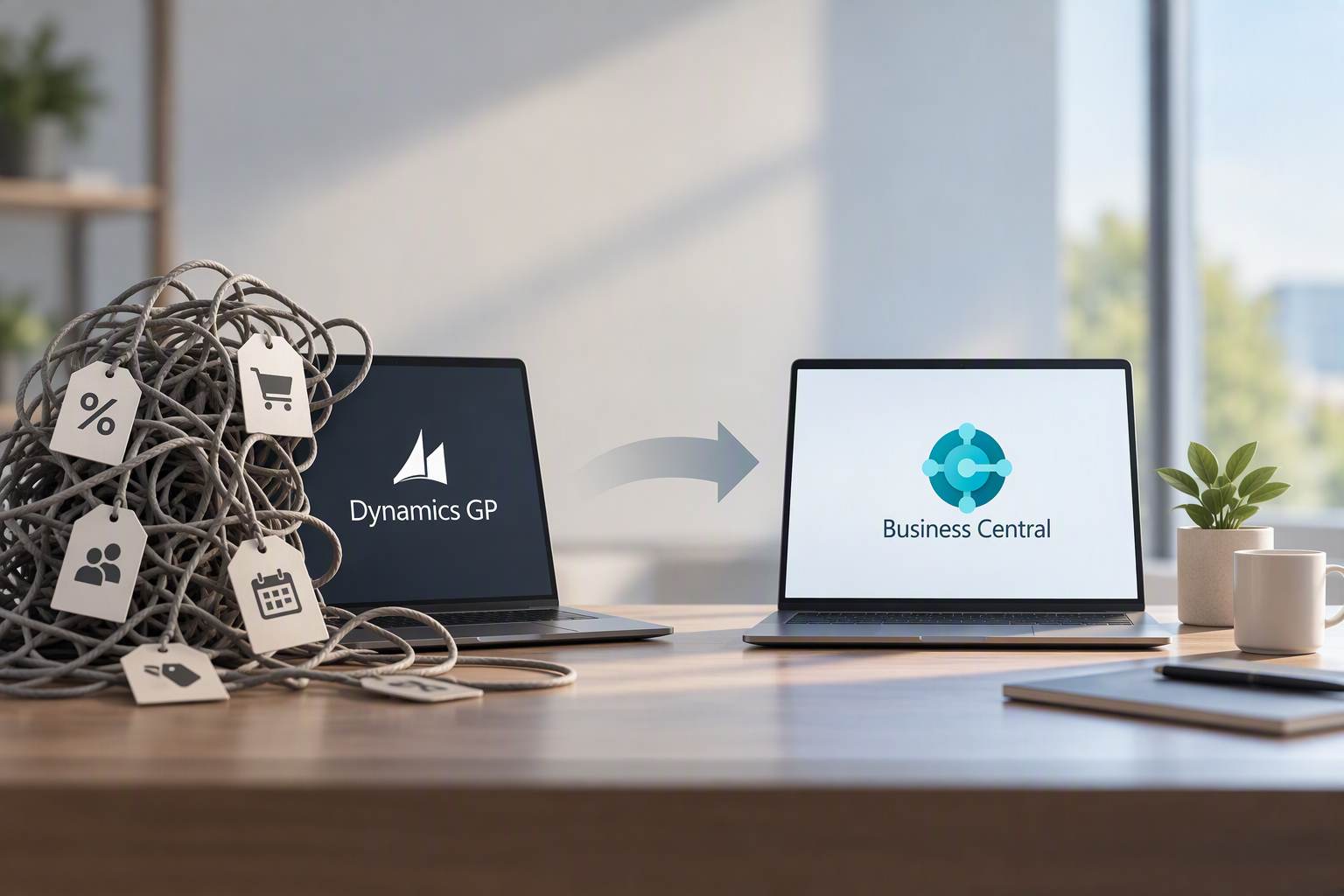
When organizations migrate from Dynamics GP to Business Central, pricing usually dominates the conversation.
Can we migrate customer-specific pricing? Can we recreate our discount structures? Can we preserve our margin logic? Those are important questions.
But they are rarely the most difficult ones. Promotions usually are. Not because promotions are technically more complex than pricing. But because promotions rarely live in one place. In many mature Dynamics GP environments, promotional logic has evolved over years through a combination of:
- Discount Schedules
- Extended Pricing
- Dexterity customizations
- Webshop-specific campaigns
- POS promotions
- Supplier-funded marketing programs
- Manual commercial agreements
The result often works. Until someone asks a simple question: Where are our promotions actually managed today? That question alone often reveals more complexity than the pricing migration itself. And that is precisely why promotions deserve their own migration strategy. The objective should not be to recreate every historical promotion.
The objective should be to establish a promotion framework that commercial teams can still manage five years after the migration. The Dynavision Advanced Promotions Manual explicitly distinguishes discounts from promotions and introduces a framework where promotions are built from audiences, conditions and promotional outcomes rather than traditional line-level pricing logic.
Most ERP Systems Are Designed for Discounts. Not Promotions.
This is the first misconception that appears in almost every GP migration project. Organizations often assume promotions are simply another form of discount. They are not.
A discount answers a relatively straightforward question: What price should the customer pay?
A promotion answers a very different question: What reward should the customer earn?
That distinction becomes critical in wholesale, beverage and distribution businesses. Consider a few common commercial scenarios:
- Buy 10 cases and receive 1 case free.
- Buy products across multiple brands and receive a supplier-funded rebate.
- Purchase a complete assortment and earn a promotional reward.
- Reach a spending threshold and unlock additional benefits.
- Buy from a category rather than a specific SKU.
These are not pricing questions. They are campaign-management questions. Traditional ERP pricing engines typically operate at line level. Promotions often depend on the complete order, customer segment, period, assortment or commercial objective. That is exactly why many GP environments gradually accumulated workarounds. The Dynavision framework explicitly separates line-level discounts from document-level promotion logic.
Dynamics GP Customers Are Rarely Replacing a Promotion Engine
They’re replacing years of workarounds. One of the most useful ways to look at promotion migration is to stop asking: Which Dynamics GP module are we replacing? And start asking: Which workarounds have accumulated over the years?
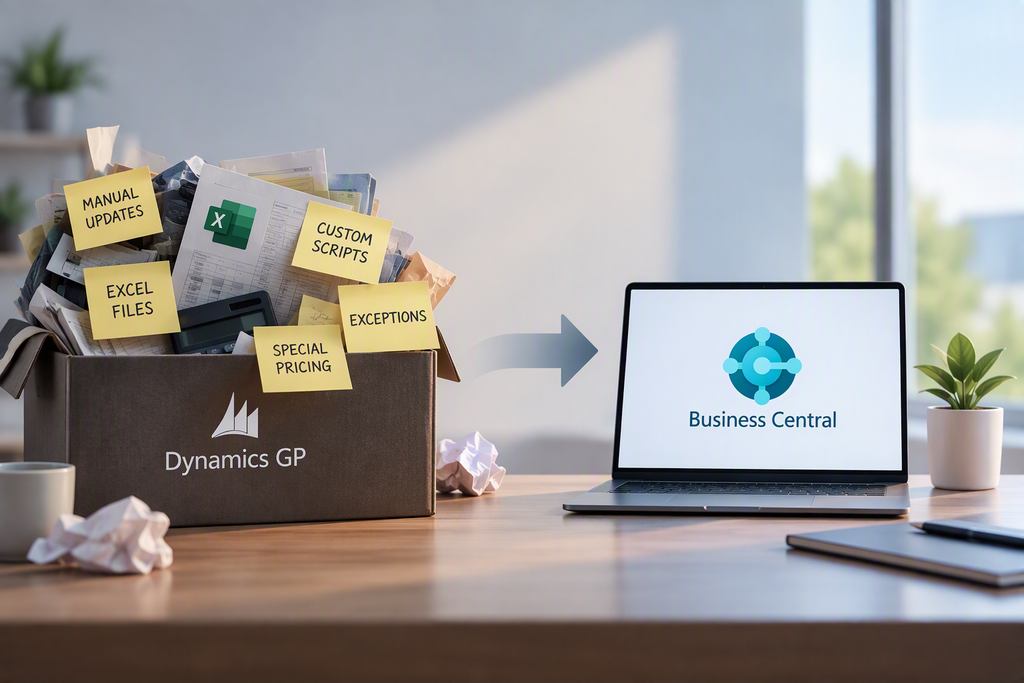
Discount Schedule Based Promotions
Many organizations use Discount Schedules for relatively straightforward campaigns.
That works well until promotions become dependent on multiple order lines, product combinations or order values.
Extended Pricing Used as a Promotion Engine
Extended Pricing was designed for advanced pricing and discounting.
Yet many organizations gradually started using it to represent promotional concepts it was never designed to manage.
Eventually commercial campaigns become embedded inside increasingly complex pricing structures.
Dexterity Developments
This is often where migration projects become interesting.
Many GP environments contain custom logic for:
- Buy One Get One Free
- Free Goods Programs
- Seasonal Campaigns
- Brand Incentives
- Category Promotions
- Customer Rewards
- Order-Value Promotions
The challenge is not that these developments no longer work.
The challenge is that every new campaign becomes an IT project.
Promotions Managed Outside GP
This is probably the most common scenario.
Promotions exist in:
- The webshop
- The POS
- Sales spreadsheets
- Customer agreements
- Supplier programs
In many companies, promotional policy is spread across multiple systems with no single point of control.
The Dynavision framework provides a promotion model inside Business Central while also supporting scenarios involving external systems.
The real migration opportunity is therefore not replacing a GP module. It is replacing fragmentation.
The Promotions That Usually Create Problems During Migration
The easiest promotions are rarely the issue. The difficult conversations start when organizations discover how many commercial campaigns actually depend on document-level logic.
Examples include:
Buy X Cases, Get Y Free
A wholesaler sells beverages in multiple packaging units. The reward depends on accumulated quantities across multiple lines.
Mixed Assortment Campaigns
A brewery launches a campaign encouraging customers to purchase a complete range rather than a single product. The promotion depends on the assortment composition of the order.
Supplier-Funded Promotions
A manufacturer subsidizes a temporary campaign. The reward structure has a promotional objective rather than a pricing objective.
Category Promotions
The campaign applies across a category rather than a specific item.
Customer Segment Incentives
Hospitality customers qualify. Retail customers do not.
Order Value Rewards
Customers receive benefits after reaching a spending threshold. These are precisely the scenarios where organizations often discover that pricing and promotions should be treated separately. Dynavision supports document-level evaluation through promotion conditions including Header Check, Contains Line and Line Summation logic.
From Promotional Rules to Promotional Models
This is arguably the most important shift in thinking. Most mature GP environments manage individual promotional rules. The organization creates a promotion. Then creates a similar promotion. Then creates another variation. Eventually hundreds of promotional records exist.
The commercial objective remains clear. The underlying logic becomes increasingly difficult to manage. Dynavision introduces a fundamentally different model.
Promotions are separated into:
- Audience
- Conditions
- Results
- Validity periods
- Application methods
A promotion therefore becomes a reusable commercial model rather than an isolated configuration. The solution supports multiple condition types and multiple promotional result types that can be combined together. That distinction may sound subtle.Operationally, it is significant.
The conversation shifts from: How do we configure this promotion?
to: Which promotional model are we trying to support?
That is a far more scalable approach.
Why Templates Matter More Than Features
Many promotion engines focus on what can be configured. The more important question is: How will this be managed by commercial teams? Dynavision supports global templates, customer-specific templates and manual configuration. Templates can be downloaded, reused and adapted for recurring promotional scenarios. The strategic benefit is not faster setup. The strategic benefit is consistency.
Templates allow organizations to standardize recurring promotion models:
- Supplier campaigns
- Seasonal incentives
- Free goods programs
- Assortment promotions
- Brand activations
Without forcing users to redesign the promotion logic every time. This is also where Dynavision adds value beyond software. Templates form the foundation for partner enablement, pre-sales support, implementation methodology and end-user training.
Why Beverage, Wholesale and Distribution Companies Benefit Most
Promotions in distribution environments are rarely simple percentages. They are commercial programs designed to influence buying behavior. A distributor wants customers to buy complete assortments. A brewery wants to activate seasonal campaigns. A supplier wants to drive specific product groups. A wholesaler wants to move slow-moving inventory.
These scenarios rarely fit naturally into traditional discount structures. They depend on the complete order, customer and commercial context. That is precisely why Dynavision separates campaign management from pricing management and provides support for advanced document-level promotion logic.
The Real Opportunity During a GP Migration
Most migration discussions begin with a preservation mindset: How do we rebuild our existing promotions? That feels safe. It is not necessarily strategic. The better question is: Which promotional programs are important enough to support in the future? Because most organizations are not migrating promotions. They are rationalizing them. Some campaigns should disappear. Some should be simplified. Others deserve to become reusable promotion templates.
The objective is not to preserve years of accumulated workarounds. The objective is to preserve commercial intent. That is where the true value of the migration lies. Dynavision Advanced Promotions provides the framework to make that transition from a collection of legacy promotional rules to a governed promotion architecture inside Business Central.
Conclusion
Promotions are often one of the most underestimated areas of a Dynamics GP migration. Not because they are difficult to configure. Because they expose years of commercial complexity that has gradually been distributed across multiple systems, customizations and processes. Pricing logic can often be migrated. Promotion logic usually needs to be rethought.
The Dynavision Advanced Promotions Manual demonstrates a different approach. Instead of treating promotions as sophisticated discounts, it provides a framework for managing campaigns through audiences, conditions, promotional outcomes and reusable templates.
The question is therefore not: How do we recreate our old promotions? The better question is: What promotion framework do we want to manage going forward? That is ultimately the difference between a technical migration and a business transformation.
Planning a Dynamics GP to Business Central migration?
Let Dynavision help you analyse your current promotion landscape, identify promotion-related customizations and design a promotion framework that is easier to govern, maintain and scale in Business Central.

