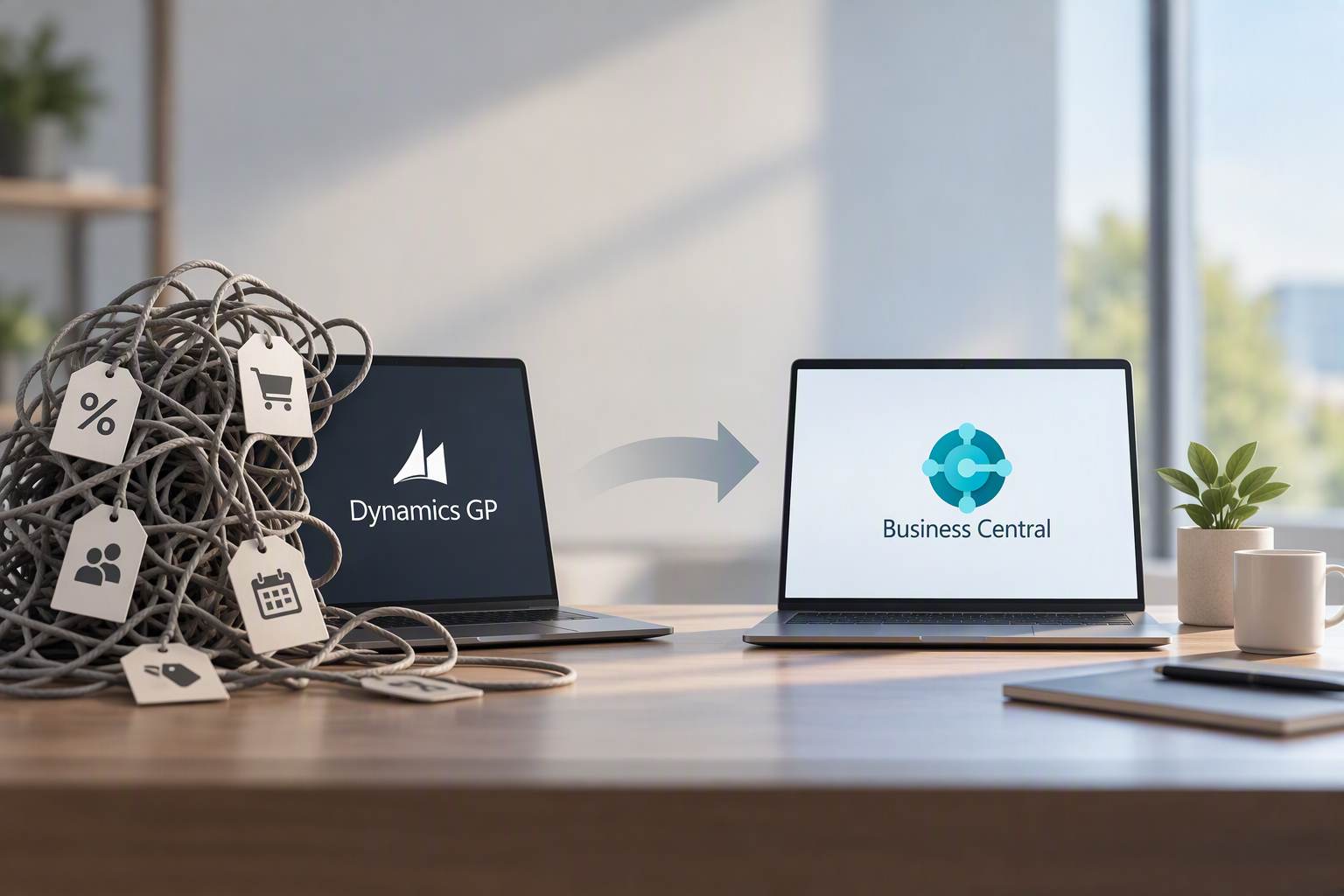
Business Central Is not the problem
Microsoft Dynamics 365 Business Central is a strong ERP foundation. It gives organizations a robust platform for finance, purchasing, sales, and inventory management. And for many companies, that foundation is more than enough. Until complexity kicks in.
Because in distribution environments like wholesale, trade, beverage and fast moving consumer goods (FMCG) growth rarely means “more of the same”. It means more exceptions. More customer agreements, delivery logic, units of measure and more operational edge cases that don’t fit neatly into standard ERP flows.
That’s usually the moment when companies start compensating outside the system:
Excel sheets become operational tools. Manual corrections become normal. Customizations pile up. Not because Business Central is failing. But because standard ERP logic was never designed around the operational reality of modern distribution.
Distribution runs on exceptions, not standards

Most ERP systems are built around consistency:
- One unit of measure per item
- One delivery date per order
- One pricing structure per document
Distribution businesses don’t work like that.
In reality, companies are:
- Selling in cases
- Shipping in pallets
- Invoicing in pieces
- Working with customer-specific agreements
- Combining deliveries
- Splitting shipments
- Managing temporary promotions and margin rules
Standard Business Central can support many of these scenarios individually. The challenge appears when they all need to coexist inside one operational flow. That’s where fragmentation starts. Processes get spread across multiple screens, manual interventions increase, and operational knowledge lives in the heads of experienced employees instead of inside the system itself. And that becomes a scalability problem.
Solutions like Dynavision Trade extend the standard Business Central flows with capabilities built specifically for distribution operations, from recurring documents and advanced shipment combinations to barcode handling and document control, without forcing companies into heavy custom development.
Planning and delivery: where ERP friction becomes visible
When distribution companies talk about ERP limitations, the issue is rarely finance. The real friction usually appears in planning and logistics. Questions like:
- Why does the promised delivery date ignore transport realities?
- Why does replanning still happen manually?
- Why is there no operational connection between cut-off times, routes, and warehouse flows?
- Why does customer service lack visibility when orders change?
These are not edge cases in distribution. They are daily operational requirements. Standard Business Central is primarily document-driven. Modern distribution operations are logistics-driven. That difference matters.
Advanced distribution environments need planning logic that understands Shipping agents and cut-off times, Delivery calendars, Combined order flows, Warehouse grouping & sequencing and also Multi-order planning scenarios.
Dynavision Planning & Dispatch was built around exactly that operational layer: structured delivery scheduling, transport logic, order accumulation, and warehouse orchestration that reflects how distributors actually work day to day.
Units of measure: the hidden complexity layer
One of the most underestimated growth blockers in distribution is units of measure. At first glance, it looks simple. In practice, it touches almost every operational process.
A single item can be:
- Sold per piece
- Picked per box
- Planned per pallet
- Priced differently depending on the unit
- Calculated by weight or packaging configuration
Standard Business Central supports basic unit conversions, but modern distribution often requires far more flexibility:
- Unit classes
- Invoicing-specific units
- Advanced rounding logic
- Packaging-based calculations
- Weight management linked to operational flows
Without that flexibility, organizations usually end up choosing between two bad options:
simplifying operational reality, or building workarounds around it. Neither scales well.
Dynavision Advanced Units adds a more structured data model for unit management inside Business Central, helping pricing, logistics, operations, and invoicing work from the same operational logic instead of disconnected interpretations.
Why heavy customization is usually the wrong answer
When standard ERP functionality falls short, customization is often the default reflex. But over time, that approach creates its own problems: Expensive upgrades, Dependency on specific developers, Difficult partner transitions and Increasing distance from Microsoft’s roadmap.
The smarter long-term strategy is not rewriting the ERP core. It is extending it intelligently.
This means keeping the standard Business Central foundation intact, adding purpose-built extensions for sector-specific operations and preserving upgradeability and flexibility. This architectural philosophy is exactly why modern Business Central extension models exist in the first place.
The goal should never be to “customize everything”.
The goal should be to create operational depth without creating technical debt.
Business Central needs a distribution lens
Business Central remains one of the strongest ERP platforms on the market. But distribution companies do not need a generic ERP system. They need an ERP platform that understands operational complexity.
That means:
- Process depth without custom code
- Operational control without spreadsheets
- Scalability without rigidity
The answer is not replacing Business Central. And it is not over-customizing it either. The real opportunity lies in extending the platform with focused distribution expertise, operational understanding and a long-term architectural vision. That’s the moment Business Central stops being standard ERP software and starts becoming a true distribution platform.
Running Business Central in a distribution-heavy environment?
Explore how Dynavision extends standard ERP to match distribution complexity, without sacrificing maintainability or upgradeability.