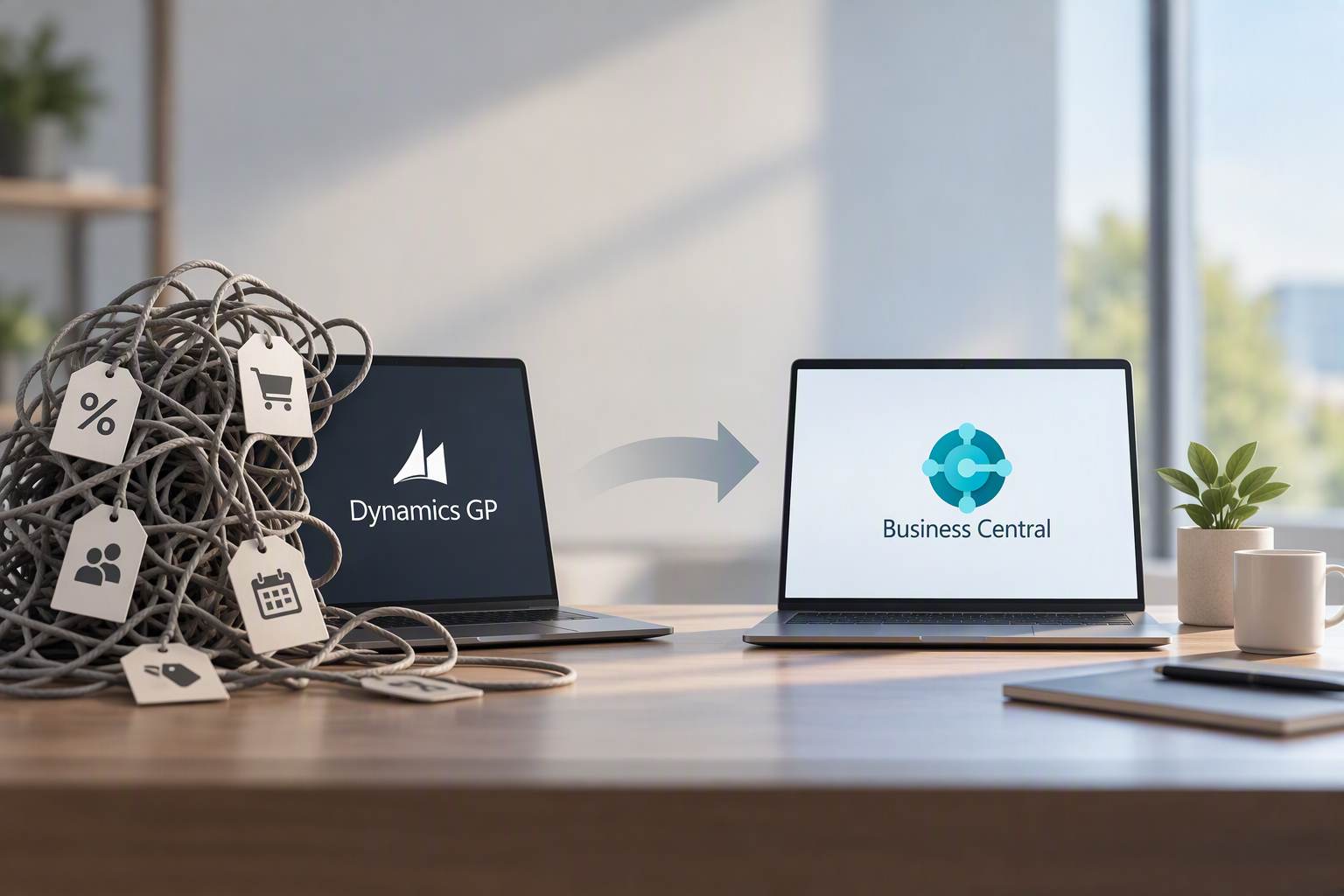
One of the most common reflexes in any Business Central implementation is customization. A requirement doesn’t fit perfectly? Adjust the system. A process feels too rigid? Modify the logic. At first glance, customization gives a sense of control. It promises a system that mirrors your business exactly.
But that control often comes with hidden costs. Costs that only become visible months or years after go-live. What starts as a practical solution often turns into a layer of complexity that slows down future decisions. More and more companies are realizing that instead of building everything themselves, structured extensions offer a smarter path to evolve their ERP landscape.
Why customization accumulates risk over time
Customization is rarely a problem in isolation. The real issue is accumulation. Each modification introduces a small layer of complexity. Over time, those layers start interacting in unpredictable ways.
Upgrade challenges
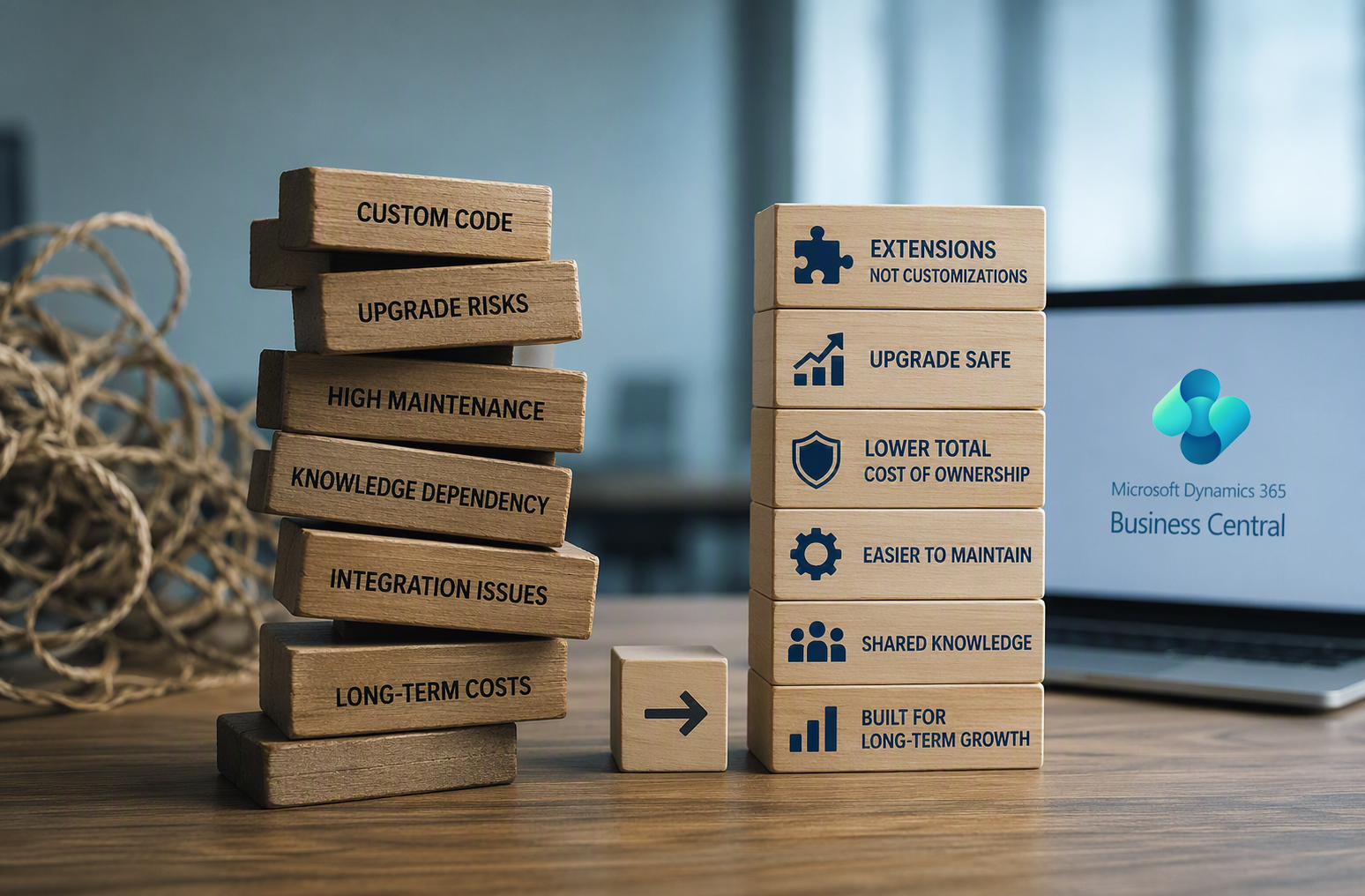
Business Central evolves continuously. New features, performance improvements, and compliance updates are released frequently. Heavy customization makes it harder to benefit from these advancements because every upgrade risks breaking custom-built logic.
Instead of moving forward with the platform, companies often find themselves maintaining outdated versions or investing heavily in regression testing and rework.
Knowledge dependency
Custom solutions tend to live in the heads of the people who built them. When those individuals are unavailable, knowledge becomes fragmented. This creates operational risk and slows down decision-making.
In contrast, standardized extensions rely on shared knowledge and documented functionality, reducing dependency on individual expertise.
Process fragmentation
Customization often leads to processes that no longer follow a consistent structure. Instead of working within a unified system, users rely on workarounds, manual interventions, or external tools.
This is exactly the type of fragmentation that Business Central is meant to eliminate. In distribution environments especially, complexity already exists naturally in areas like pricing, units of measure, and logistics. Adding custom logic on top of that only amplifies the problem.
The illusion of “perfect fit”
Customization is often justified by the idea of achieving a perfect fit. But in reality, business processes are not static. Markets evolve. Customer expectations shift. Internal workflows change. A system that is perfectly tailored today can become a constraint tomorrow.

The more rigid the customization, the harder it becomes to adapt. What once felt like precision turns into inflexibility.
A different approach: extending instead of modifying
Instead of modifying the core system, a growing number of companies are adopting an extension-based approach. This means building functionality on top of Business Central rather than changing its foundation.
This approach brings several advantages:
- It preserves compatibility with future updates
- It keeps the system aligned with standard architecture
- It allows for modular growth
- It reduces technical debt
Dynavision’s add-ons are built with exactly this philosophy in mind. Rather than replacing standard functionality, they extend it in a structured and upgrade-safe way.
For example, pricing complexity is not solved by rewriting pricing logic, but by layering advanced calculation methods and hierarchical structures on top of standard pricing. Similarly, synchronization challenges are addressed through configurable data synchronization mechanisms instead of custom integrations.
This ensures flexibility without sacrificing stability.
What scalable ERP really looks like in practice
Scalability in ERP is often misunderstood. It’s not about handling more transactions or adding more users. It’s about maintaining clarity and control as complexity increases.
In real-world distribution scenarios, complexity is unavoidable:
- Different units of measure across sales, logistics, and invoicing
- Customer-specific agreements and pricing structures
- Dynamic delivery planning and logistics constraints
Solutions like advanced unit handling, planning and dispatch capabilities are designed to manage this complexity within a structured framework, rather than bypassing it with custom logic. That’s the difference between scaling operations and scaling problems.
From short-term fix to long-term strategy
Customization is often driven by short-term needs. A project deadline, a specific customer requirement, or a perceived limitation in the system.
But ERP decisions should always be evaluated in a long-term context. The question is not whether something works today, but whether it will still work efficiently in two or three years. An extension-first strategy forces that mindset. It shifts the focus from quick fixes to sustainable solutions.
It also creates a stronger collaboration model between partners, ISVs and end customers. Where functionality is reusable, knowledge is shared and innovation is continuous.
Conclusion
Customization in Business Central is not inherently wrong. In some cases, it is necessary. But it should never be the default approach.
The hidden cost of customization is not just technical, it’s strategic. It impacts scalability, adaptability, and long-term value.
Companies that move towards an extension-based model don’t just reduce risk. They position themselves to grow faster, adapt more easily, and get more out of their ERP investment.
Curious how you can reduce customization while still covering complex business needs?
Let’s explore how Dynavision’s upgrade-safe extensions help you build a scalable and future-proof Business Central environment.