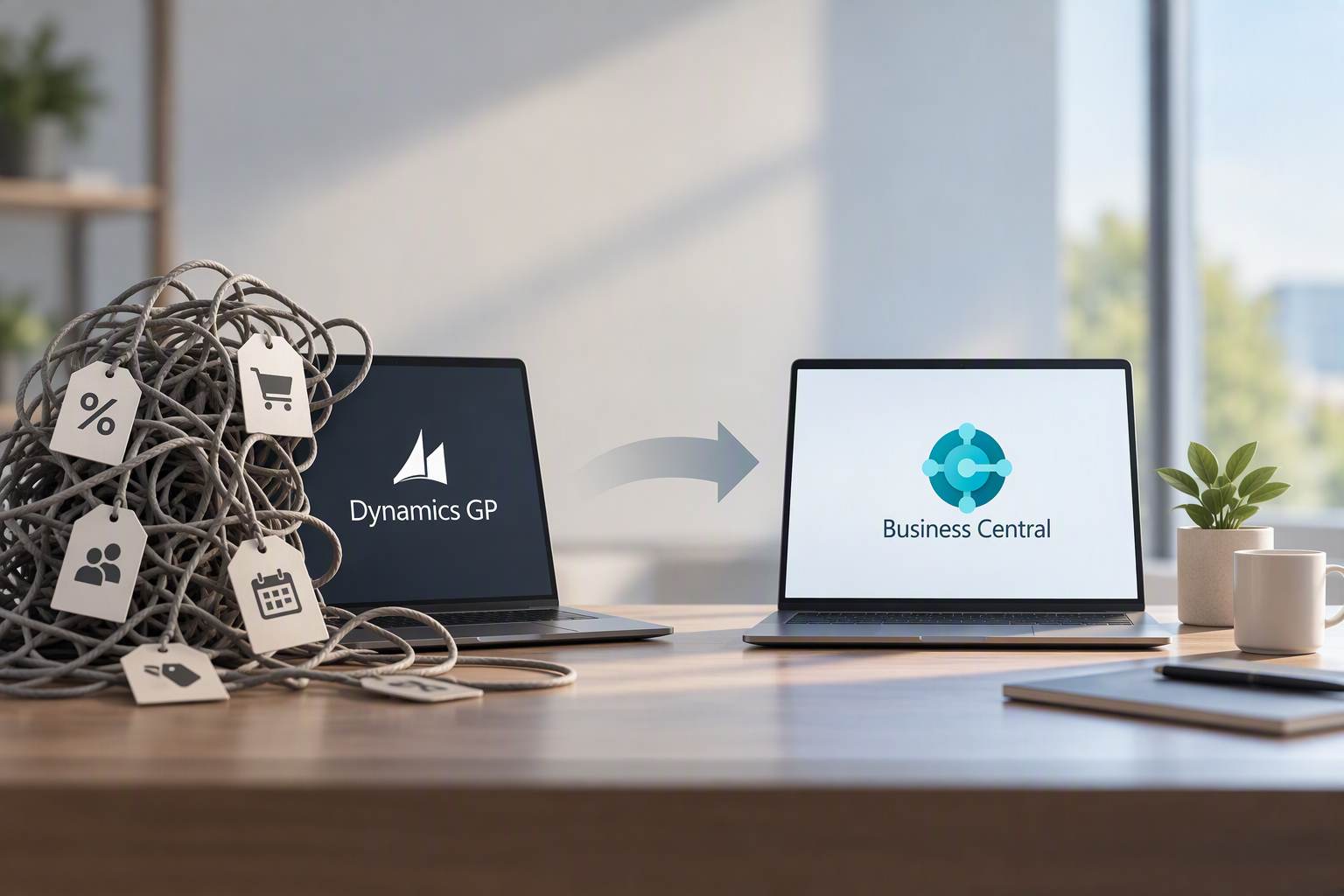
Walk into almost any distribution company, and you’ll find the same pattern: promotions are managed in Excel.
At first glance, this seems harmless. Spreadsheets are flexible, easy to use, and familiar to everyone involved. But as soon as promotions become more frequent, more complex, or more business-critical, cracks start to appear.
Multiple versions begin circulating across teams. Assumptions differ between sales and operations. Updates are communicated manually, often through email or informal channels. What started as a quick workaround gradually becomes the backbone of how promotions are handled.
The real issue, however, is not Excel itself. It’s the fact that promotions are treated as isolated initiatives rather than as structured business processes embedded in the core system.
Why Excel promotions break at scale
The moment a distribution business grows, spreadsheet-driven promotions start to create friction across the organization.
First, there is a clear lack of control. Spreadsheets don’t enforce rules or validation. Anyone can adjust logic, override prices, or interpret conditions differently. This leads to inconsistent execution, where the same promotion might be applied differently depending on who processes the order.
Second, promotions in spreadsheets are disconnected from operations. Promotions don’t just influence pricing: they directly impact demand, stock levels, and delivery planning. When they live outside the ERP system, there is no direct link to order intake, inventory, or logistics processes. That disconnect makes it difficult to anticipate demand spikes or align deliveries efficiently. Systems built for planning and dispatch are designed to handle these dynamics, but they need structured input to do so.
Finally, there is limited visibility on margins and impact. Without integrated pricing logic, companies struggle to understand the real profitability of promotions. Discounts are applied, but the broader pricing strategy remains disconnected, creating blind spots in margin control.
The shift to structured promotion management with Business Central
Forward-looking distribution companies are starting to recognise that promotions are not temporary adjustments. They are a fundamental part of their commercial strategy.
This leads to a shift from ad hoc, spreadsheet-driven workflows to structured promotion management within the ERP environment.
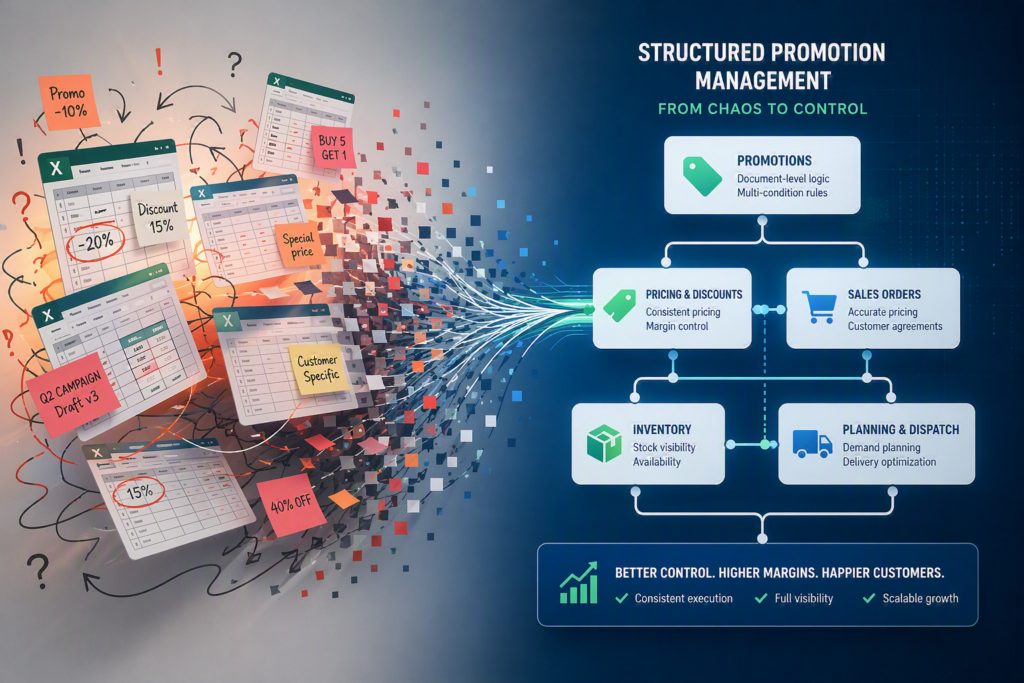
This shift is not just about replacing Excel with software. It’s about redefining promotions as controlled, rule-based processes that are fully integrated with pricing, sales, and operations.
What structured promotion management really means
A common misconception is that promotions are simply discounts. In reality, they are far more complex and require a different kind of system logic.
One key element is the move from line-level logic to document-level logic. Instead of applying a discount to a single item line, structured promotion systems evaluate the entire transaction. This allows conditions to span multiple products, quantities, or combinations, reflecting how promotions actually work in real life.
In addition, structured promotions support multi-condition scenarios. These can include volume-based incentives, bundled offers, customer-specific agreements, or time-bound campaigns. Managing these reliably requires a system that can evaluate multiple conditions simultaneously and apply consistent logic.
Pricing also becomes part of the same framework. Instead of working with isolated discounts, companies can align promotions with broader pricing strategies, ensuring consistency across customers and channels. This reduces the risk of margin erosion and creates a more controlled commercial model.
From operational chaos to coordination
When promotions are structured and integrated, their impact goes far beyond pricing.
Operations teams gain better visibility into upcoming demand. Planning tools can anticipate peaks and adjust delivery schedules accordingly. Logistics processes become more efficient, with fewer last-minute changes and better alignment between orders and shipments.
This is where the connection with planning and dispatch becomes critical. When promotion data is part of the system, delivery scheduling, order promising, and shipment consolidation can all take it into account. Instead of reacting to demand, companies can proactively manage it.
The result is a shift from reactive firefighting to coordinated execution across departments.
Where standard ERP setups fall short
Many standard ERP environments are not designed to handle this level of complexity out of the box.
Promotions are often limited to basic discount functionality or static pricing rules. While this works for simple scenarios, it quickly becomes insufficient when companies need to manage more advanced promotional logic.
This gap is exactly why spreadsheets persist. When the system cannot support the business process, users revert to external tools, even if that introduces inefficiencies and risks.
Enabling structured promotions in Business Central
To bridge this gap, additional functionality is needed on top of the standard ERP platform.
With Dynavision Advanced Promotions Manual.pdf, promotions are treated as structured processes rather than isolated discounts. The module supports both basic and advanced promotions, with the latter allowing conditions that span multiple lines and require recalculation at document level.
When combined with other modules, the full picture becomes clear:
- Dynavision Advanced Pricing & Discounts ensures pricing consistency and margin control through advanced pricing logic
- Dynavision Planning & Dispatch connects promotions to operational execution, enabling better planning and delivery coordination
- Dynavision Advanced Item & Price import allows companies to transition from Excel-based inputs to structured data imports, without losing flexibility
Together, these capabilities turn promotions into an integrated, manageable part of the business process within Business Central.
The strategic payoff
The real value of structured promotion management is not just efficiency. It’s control.
Companies gain:
- Consistent execution across teams
- Clear visibility on margins and performance
- The ability to scale promotions without adding complexity
Most importantly, they create a foundation where growth does not automatically lead to operational friction.
Promotions evolve from a source of chaos into a lever for controlled, profitable growth.
Still managing promotions in Excel?
It might be time to rethink not just your tools, but your entire process.